
Timing Belt vs. Timing Chain: Which One Does Your Car Have and Why It Matters
You are driving down I-5 through Lakewood, enjoying a smooth commute, when suddenly your engine cuts out. No sputtering, no warning: just a total loss of power. You pull over to the shoulder, and when you try to restart the car, you hear a fast, hollow whirring sound, but the engine won't catch.
If you’re driving a vehicle with over 80,000 miles, this scenario is a very real possibility if you haven't checked your timing system lately. Whether your car uses a timing belt or a timing chain, these components are the "conductors" of your engine’s orchestra. They ensure that your valves and pistons move in perfect harmony. When that harmony is broken, the results range from a simple stall to a catastrophic engine failure that could cost thousands to repair.
At Proformance Complete Auto Care, we believe that understanding your car shouldn't require a degree in mechanical engineering. Let’s break down the differences between these two systems, how to spot trouble, and why staying on top of car maintenance in Lakewood is the best way to keep your vehicle on the road for the long haul.
The Basics: What Do They Actually Do?
Think of your engine as a precision timepiece. Inside, pistons move up and down while valves open and close to let air in and exhaust out. If a valve opens at the wrong time, it could be struck by a rising piston. To prevent this, the crankshaft (which controls the pistons) and the camshaft (which controls the valves) must be perfectly synchronized.
The timing belt or timing chain is the component that links these two shafts together.
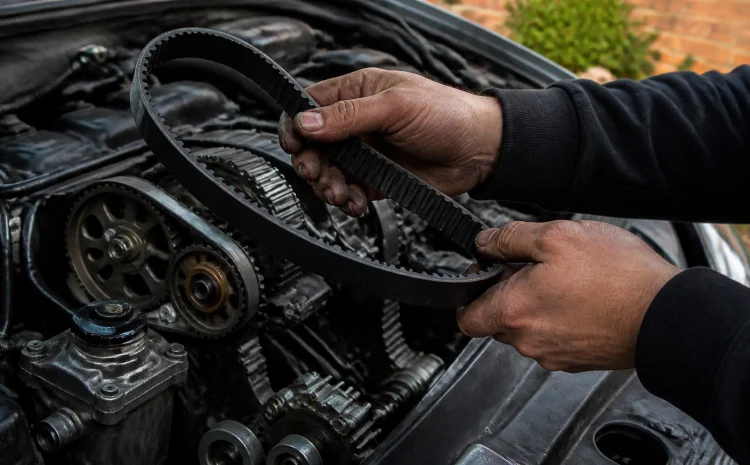
- A Timing Belt is a heavy-duty, reinforced rubber belt with teeth on the inside. It usually lives on the outside of the engine behind a plastic cover.
- A Timing Chain is a metal chain that looks much like a heavy-duty bicycle or motorcycle chain. It is located inside the engine and is continuously lubricated by engine oil.
How to Tell What Your Car Uses
Most modern vehicles have moved toward timing chains because they are designed to last the life of the engine. However, many popular models: especially those from Honda, Toyota, and various European manufacturers: still utilize timing belts.
If you aren't sure what you have, the easiest way to check is your owner’s manual. You can also look at the front of your engine. If you see a plastic cover, you likely have a belt. If you see a sealed metal cover that looks like part of the engine block, you likely have a chain.
If your car is approaching that 80,000-mile or 100,000-mile mark, knowing which one you have is critical. A belt is a wear item; a chain is (usually) a "for life" item, provided you keep up with oil changes.
The 80,000-Mile Milestone: Why Timing Belts Matter
If your car uses a timing belt, it has a finite lifespan. Because it is made of rubber, it eventually dries out, cracks, and loses its structural integrity. Most manufacturers recommend a timing belt replacement every 60,000 to 100,000 miles.
For drivers in the Pacific Northwest, our damp winters and fluctuating temperatures can accelerate the aging of rubber components. If you’ve reached 80,000 miles and haven't replaced your belt, you are entering the "danger zone." Unlike a tire that might show a slow leak or a brake pad that squeals, a timing belt often gives no warning before it snaps. One second your car is running perfectly; the next, it’s a giant paperweight.

Warning Signs: Is Your Car Trying to Tell You Something?
While timing belts often fail silently, timing chains are a bit more "vocal" when they have issues. Since chains are metal and rely on oil, they tend to stretch or wear down the guides that hold them in place. Here is what you should listen and look for:
- A Ticking or Rattling Sound: If you hear a "clatter" coming from the front of the engine, especially when you first start the car or while it's idling, it could be a loose timing chain or a failing belt tensioner.
- Engine Misfires: If the belt or chain stretches even slightly, it can cause the timing to be "off" by a fraction of a second. This results in poor combustion, rough idling, and a noticeable lack of power.
- The Check Engine Light: Modern cars are incredibly smart. They use sensors to monitor the position of the crankshaft and camshaft. If they fall out of sync, the computer will trigger a code, often related to "camshaft correlation."
- Oil Leaks: For cars with timing belts, an oil leak from the front of the engine can be a death sentence for the belt. Oil degrades rubber quickly, causing the belt to slip or snap prematurely.
The "Interference Engine" Nightmare
The most important reason to stay on top of this maintenance is a design feature called an "interference engine." In these engines, the space where the valves open and the space where the pistons move actually overlap. They only stay apart because the timing belt keeps them in a perfectly choreographed dance.
If the belt snaps, the dance stops. The valves stop moving, but the pistons: pushed by the momentum of the car: keep flying up and down. They will slam into the open valves, bending them, shattering pistons, and potentially destroying the entire engine block.
In a "non-interference" engine, your car will simply stop running, but the internal parts won't hit each other. However, the majority of modern, high-compression engines are interference designs. A timing belt replacement is a bargain compared to a $5,000 engine rebuild.
Timing Chain Reliability: The Role of Engine Oil
If you have a timing chain, you might think you’re off the hook. While chains don't have a scheduled replacement interval like belts, they are highly sensitive to the quality of your oil.
The timing chain is kept tight by a hydraulic tensioner that uses engine oil pressure. If you skip oil changes, the oil becomes dirty and abrasive, wearing down the chain links and the plastic guides. Eventually, the chain "stretches" (the pins wear down, making the chain longer), which causes the rattling we mentioned earlier. If you want your timing chain to last 200,000 miles, you must change your oil every 5,000 to 7,500 miles without fail.
Mobile Engine Repair in Lakewood: We Come to You
We know that major repairs like a timing belt replacement can be a massive inconvenience. Traditionally, you’d have to drop your car off at a shop, find a ride to work, and wait days to get it back.
At Proformance Complete Auto Care, we’ve changed that. Since 2018, we have provided professional, dealership-level mobile engine repair throughout the Lakewood area. Our ASE Blue Seal accredited shop employs ASE Master Technicians who bring the tools, expertise, and parts directly to your driveway or office parking lot.
Whether you need a diagnostic check to see if that rattling sound is your timing chain or you’re ready for a scheduled belt replacement, we handle it on-site. You get an upfront estimate, transparent pricing, and the peace of mind that comes from knowing the job was done by a certified professional while you were in the comfort of your own home.
Protect Your Engine Today
Your car’s timing system isn't something you can afford to "wait and see" about. If you’re past 80,000 miles and haven't had an inspection, or if you’ve noticed new noises coming from under the hood, it’s time to take action.
Don't wait for a breakdown to leave you stranded. Contact Proformance Complete Auto Care today to schedule your mobile diagnostic or maintenance service. We’ll help you determine exactly what your car needs and get you back on the road safely, without the hassle of the repair shop waiting room.