
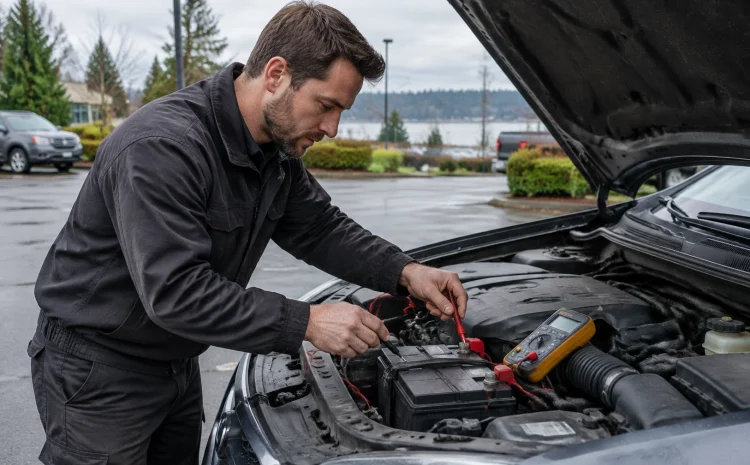
Lights Dimming at Idle? Your Charging System Is Trying to Tell You Something
You’re stopped at a red light on a dark winter commute when your headlights begin to pulse. They brighten again when you pull away, so you keep driving. Then one cold morning, the engine cranks slowly, and you wonder whether the battery is finally giving out.
That combination of dimming lights and a sluggish start can be an early sign of a charging-system problem. It doesn’t automatically mean you need a new battery or alternator, though. Several parts work together to keep your car’s electrical system running, and testing is the best way to find the actual cause before you spend money on the wrong repair.
Understand what powers your car
Your battery provides the power needed to start the engine. Once the engine is running, the alternator supplies electricity to the vehicle’s systems and recharges the battery. A belt, usually the serpentine belt, turns the alternator.
Think of the battery as the reserve tank and the alternator as the system that keeps it replenished. If the alternator can’t keep up, the battery may have to cover the difference. A weak battery, slipping belt, poor connection, or other fault can also interfere with the process.

Why the lights may dim at a stoplight
At idle, the engine, and therefore the alternator, turns more slowly than it does while you’re driving. The alternator can produce less output at lower speed. A healthy charging system should generally manage the vehicle’s electrical needs, but a weak component or connection may struggle, particularly when you’re using headlights, the heater fan, a rear defroster, or other electrical accessories.
That can make your lights dim or pulse while you wait at a stoplight, then brighten as engine speed rises. The change is a useful clue, but it doesn’t identify the failed part by itself.
A failing alternator is one possibility. So are a worn or glazed belt that slips on its pulleys, a loose or corroded battery terminal, a failing voltage regulator, a weak battery, or a poor ground connection. The ground is part of the electrical return path; if it has too much resistance, current can’t flow as it should.
Watch for these related warning signs
Dimming headlights may be the first clue, but charging-system trouble can show up in other ways:
- Dashboard or interior lights flicker, especially at idle.
- The radio cuts out, or power windows move unusually slowly.
- The battery or charging-system warning light comes on.
- The engine cranks slowly, particularly on cold mornings.
- You’ve needed a jump-start, or the battery seems to go flat again.
- You notice a burning-rubber smell, which can point to a slipping belt.
A burning smell deserves prompt attention. If you see smoke, hear a new belt squeal, or notice the charging warning light along with other electrical problems, pull over somewhere safe and switch off the engine. Avoid reaching near a moving belt or attempting roadside repairs; arrange for professional help.
Battery or alternator? The symptoms can overlap
A weak battery can struggle to start the car, while a faulty alternator can leave the battery undercharged as you drive. Because each can affect the other, symptoms alone aren’t a reliable diagnosis.
As a rough clue, a car that starts with a jump but dies again soon afterward may have an alternator or charging-circuit problem. A car that won’t crank at all despite bright lights may have a battery or connection issue. These are possibilities, not rules: wiring faults, a starter problem, and other issues can produce similar symptoms.
That’s why replacing parts based on a guess can get expensive. A fresh battery won’t fix an alternator that isn’t charging it, and a new alternator won’t solve a bad ground or corroded cable. DENSO’s charging-system diagnostic guidance likewise recommends checking the battery, cables, grounds, and belt as part of diagnosing charging performance.
Get the system tested instead of guessing
A useful diagnosis checks the battery’s condition, alternator output, and the electrical connections under load. Testing under load means checking how the system behaves while electrical accessories are drawing power. A voltage-drop test can help reveal resistance in cables or grounds that may not be obvious from a visual check.
A technician may also inspect belt condition and tension, terminals, wiring, and ground connections. The goal is to identify whether the issue is the battery, alternator, regulator, belt, or another part of the circuit, not to replace components until something works.
If your lights dim at idle and the engine is cranking slowly, book an inspection before the car leaves you stranded. The vehicle and electrical diagnostics team at Proformance Complete Auto Care can test the charging system and recommend the next step.
Have the car checked where it’s parked
When a vehicle may not restart, getting it to a repair shop can be one more hassle. With a car diagnostic service at home, a technician can bring professional-grade testing equipment to your driveway, workplace, or parking lot and check the vehicle where it’s parked, without arranging a tow or waiting at a shop.
Proformance Complete Auto Care has served Lakewood, WA, since 2018. Our ASE Blue Seal accredited shop and ASE Master Technicians provide battery and charging-system service for all makes and models. You’ll receive a clear explanation and an upfront estimate before approved work begins; same-day service is available in most cases.
If you’re searching for a mobile mechanic in Lakewood, WA or the best mobile mechanic near me, choose someone who tests the whole charging system rather than guessing from one symptom. Addressing dimming lights early can help you avoid a surprise no-start.
Don’t ignore the warning signs
Headlights that pulse at idle and a sluggish crank may be your car’s way of telling you the battery isn’t being properly supported. The cause could be the alternator, belt, battery, or a connection, and testing is what separates one from another.
Book an appointment with Proformance Complete Auto Care to have your charging system checked where your car is parked.