
Why Your Car’s A/C Still Blows Warm After a Recharge (And What’s Really Wrong)
It’s a sweltering July afternoon in Lakewood, and you’ve finally reached your breaking point with the lukewarm air puffing out of your vents. You stop by the local auto parts store, grab one of those DIY “recharge in a can” kits, and follow the instructions to a T. For a few minutes, maybe even an hour, you feel a hint of a breeze that actually feels cold.
Then, reality sets in. The air turns tepid again, or perhaps it never really got cold in the first place. You’ve spent forty bucks and a sweaty hour under the hood, and you’re right back where you started: only now you’re more frustrated.
At Proformance Complete Auto Care, we see this scenario constantly. Many drivers assume that "A/C not working" is synonymous with "needs more refrigerant." While low refrigerant is a common symptom, it is rarely the actual disease. If your car's A/C still blows warm after a recharge, it’s because the system has an underlying mechanical or electrical failure that a can of gas simply cannot fix.
The Myth of the DIY Recharge Kit
The marketing on those DIY cans makes it look easy: "Just clip it on and go!" However, these kits are often a "Band-Aid" fix for a much larger problem. Automotive air conditioning is a closed, pressurized loop. In a perfect world, that refrigerant should never leave the system. If you have to add more, it means there is a hole somewhere: and usually, it’s a hole that needs a proper repair, not just more pressure.
Furthermore, these cans often include "stop-leak" additives. While they sound like a great idea, these chemicals can actually gum up the delicate internal components of your AC system, leading to an even more expensive AC compressor repair down the line. To get your cabin cold again, you need to look past the refrigerant levels and dive into the actual mechanics of the system.
1. The Invisible Enemy: Refrigerant Leaks
If you’ve just added refrigerant and the air is already warm again, you likely have a significant leak. Refrigerant is a gas that turns into a liquid under pressure; when there is a breach in a hose, an O-ring, or the condenser, that gas escapes into the atmosphere.
Because AC systems operate under high pressure, even a pinhole leak can drain a fresh recharge in less than a day. Common leak points include:
- The Condenser: Located right behind your car's grille, it’s vulnerable to rocks and road debris.
- The Evaporator: Tucked deep inside your dashboard, this is the hardest part to reach and a common site for corrosion-based leaks.
- Service Ports: Sometimes the very valves you use to recharge the car are the ones leaking.
A professional car diagnostic service at home uses UV dyes and electronic "sniffers" to find these leaks precisely so they can be sealed for good.
2. AC Compressor Failure
The compressor is the heart of your climate control system. Its job is to pressurize the refrigerant and keep it moving through the loop. If the compressor isn't working, it doesn't matter how much refrigerant you pump into the lines; the system won't circulate.

Sometimes the compressor itself has failed internally, but often the issue lies with the compressor clutch. This is the part that engages the engine's power to spin the compressor. If the clutch is worn out or seized, the compressor will stay idle while the rest of the engine runs. You might hear a loud "clack" or a grinding noise when you try to turn on the AC, or you might hear nothing at all. In either case, professional AC compressor repair or a total replacement is usually the only solution.
3. The Clogged Expansion Valve or Orifice Tube
Think of the expansion valve as the "brain" of the cooling process. It regulates how much refrigerant flows into the evaporator. If this valve gets stuck or clogged: often by the very "stop-leak" junk found in DIY cans: the refrigerant can't expand and drop in temperature.
When this happens, your gauges might show that the system is "full," but the air stays warm because the flow is restricted. A thorough AC and heating diagnosis can determine if your expansion valve is the culprit by checking the pressure differences between the high and low sides of the system.
4. Electrical Gremlins and Faulty Sensors
Modern cars are essentially computers on wheels, and the AC system is no exception. There are multiple sensors: low-pressure switches, high-pressure switches, and ambient temperature sensors: that tell the car's computer when it’s safe to run the AC.
If a pressure switch fails, it might tell the computer that the system is empty even when it's full. As a safety precaution, the computer will refuse to engage the compressor to prevent damage. You could add five cans of refrigerant, but if that sensor is dead, your vents will stay warm. This is where solving electrical problems becomes a vital part of the repair process.
5. Broken Blend Doors
Sometimes the AC system is actually working perfectly, but the air coming out of your vents is hot because of a mechanical failure inside your dashboard. Your car uses "blend doors" to mix hot air from the engine and cold air from the AC.
If the small plastic motor (the actuator) that moves these doors fails, it might get stuck on the "heat" setting. In this scenario, your AC compressor is humming along and the lines are ice-cold, but the air is being blasted through the heater core before it reaches you. No amount of refrigerant will fix a broken plastic door deep inside your dash.
Why Professional Car Diagnostic Service at Home Matters
Most people attempt the DIY recharge because they want to avoid the hassle of a shop. They don't want to deal with towing or losing their car for three days. We get it.
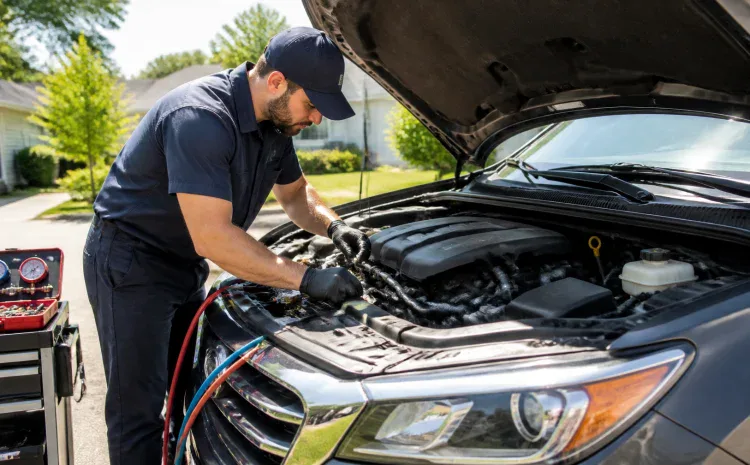
That is exactly why Proformance Complete Auto Care exists. We are a mobile AC repair service that comes directly to you in Lakewood and the surrounding areas. Since 2018, our ASE Blue Seal accredited shop has been sending ASE Master Technicians to driveways and office parking lots to perform dealership-level diagnostics.
When we arrive, we don't just "top it off." We perform a comprehensive check:
- Pressure Testing: We use professional manifold gauges to see exactly how the high and low sides are behaving.
- Leak Detection: We find the specific hole so we can give you a permanent fix.
- Electrical Scanning: We check the car's computer for fault codes that explain why the compressor isn't engaging.
- Visual Inspection: We check belts, fans, and the condenser for physical damage.
Stop Guessing and Start Cooling
Driving around Lakewood in a hot car isn't just uncomfortable; it's exhausting. If your AC is blowing warm and your DIY efforts haven't worked, don't keep throwing money at the problem with more cans of refrigerant.
Whether it's a simple O-ring replacement or a complex AC compressor repair, our team has the tools and expertise to handle it on-site. You don't have to worry about towing or waiting in a greasy lobby. We bring the shop to you, providing transparent pricing and expert service that gets you back to a cold, comfortable cabin.
Ready to stop sweating behind the wheel? Contact Proformance Complete Auto Care today and let our mobile AC repair service give you the professional diagnosis your vehicle deserves.